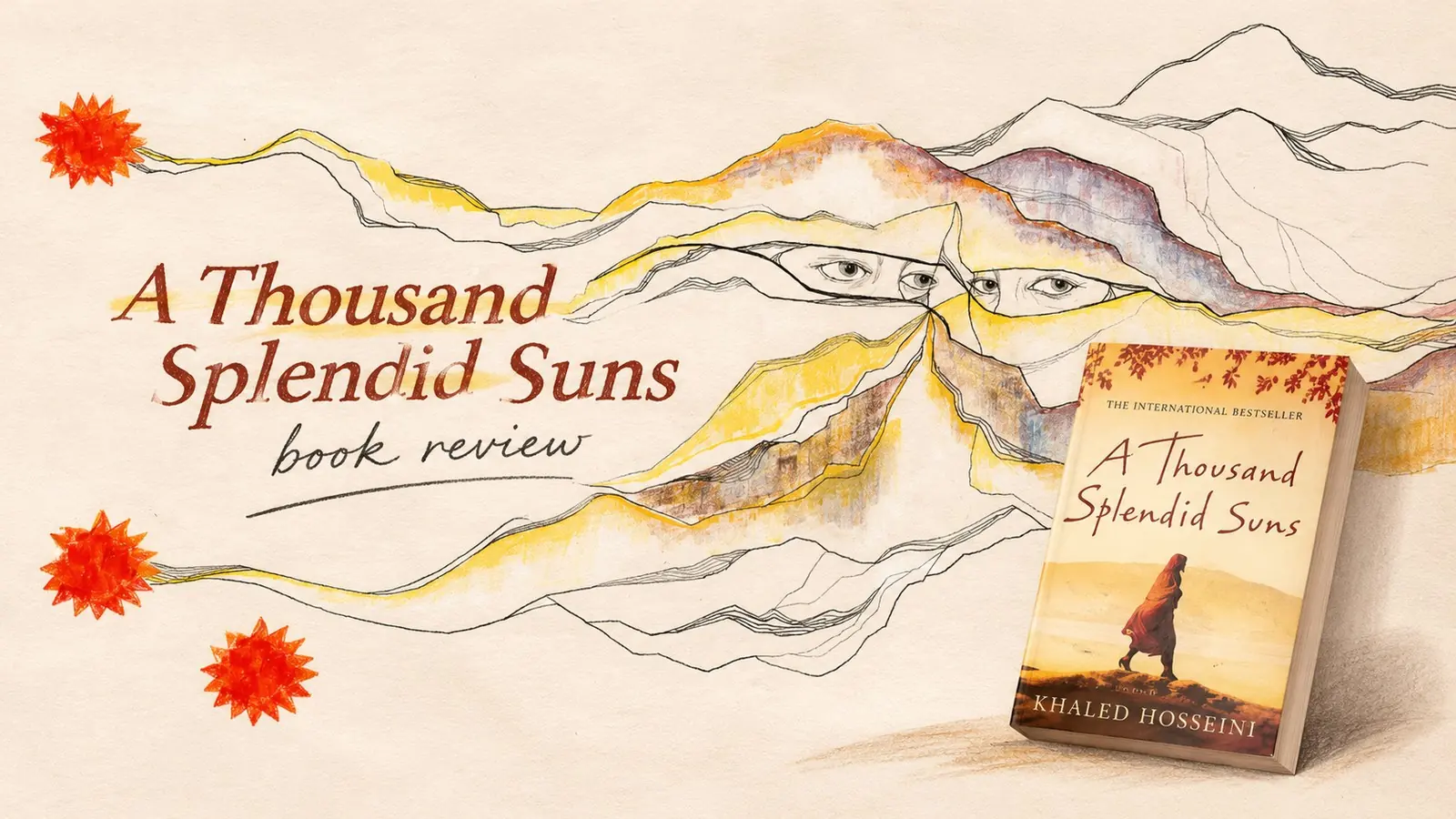
Rating: ⭐⭐⭐⭐⭐
"Everybody wants Jack," Laila said to Mariam. "That's what it is. Everybody wants Jack to rescue them from disaster. But there is no Jack. Jack is not coming back. Jack is dead."
- Khaled Hosseini, A Thousand Splendid Suns
I'm probably a bit too old to read A Thousand Splendid Suns. I'm glad I didn't care and read it anyway. It was, honestly, truly gut-wrenching. I cried, I hoped, I cried some more. The moment I felt some hope again, it was taken away more harshly than ever before. Safe to say, I finished reading the book in a day.
The book follows Mariam and Laila, two women born a generation apart whose lives end up tied together under one roof in Kabul. We see them come from different backgrounds, grow and face hardships, and ultimately choose (I use this word very carefully) to love in a world that gives them very little reason to.
Books like these never fail to remind me just how lucky I am to have things I consider "basic": a roof over my head; functional, loving parents; an education; freedom to make my own choices. Or even being born in a country that you'll hear me complaining about (but not anymore, for the most part). It was written in a way that made me feel compelled to research the Taliban and the current state of Kabul and its women for hours after I finished it.
Fair warning: the rest of this review has spoilers. If you haven't read it yet, stop here and go read it (I 100% recommend it).
Impressions
A History I Didn't Know
I did not realise Afghanistan had such a prominent and deep history. Pre-Taliban Afghanistan, at least the way the book shows it, was much more free and "beautiful". But it still had classes, and those were still incredibly brutal to women (like the clothes worn by women and the idea of a "bastard" child).
It was interesting because once the communist government fell (much awaited), the Afghans themselves split into factions and fought amongst themselves over who would rule. The end of one oppressive government didn't necessarily bring freedom or peace, especially not for ordinary women like Mariam and Laila. Then the Taliban arrive, and this line summarises it.
"Mariam heard the answer in his laugh: that in the eyes of the Taliban, being a communist and the leader of the dreaded KHAD made Najibullah only slightly more contemptible than a woman."
- Excerpt from A Thousand Splendid Suns, Khaled Hosseini
Waiting for Jack
Hope is captured especially fleetingly in this book. The moment there is some, it gets taken away, and everything comes crashing down without warning. Babi's death was particularly cruel. He represented all of the education and possibility, especially from a man towards a woman. When the rocket hits their house, the future that was so bright for Laila, beyond the life she is eventually forced into, is just taken away.
In the first quote in the review, when Laila says everybody wants Jack, she means everyone wants a knight in shining armour to come and save the day. To me, the Jack in the actual Titanic story was a fake hero as well, and this was very emblematic of that comparison.
This arc was perhaps the most inspiring to watch evolve. Initially, hope is something that happens to the characters. They hope someone will return, someone will love them, someone will change their circumstances. Increasingly, though, we see Mariam and Laila doing things themselves, however small: digging a hole, protecting the children, finding ways to survive. In the end, the tragedy wasn't simply that Jack wasn't coming. It was that they'd been taught to wait for Jack in the first place.
Ra-shit
Rasheed was just a prince among men. Obviously, that's for the big things: the abuse, patriarchy and everything he believes in. But the hate increased tenfold with the smaller things, like his obvious favour towards the boy child. At one point, he pockets the last ring of jelabi left on an abandoned coffee table and takes it home for Zalmai. He stole it only for Zalmai, when Aziza was the one who loved jelabi, and he probably didn't even know (which is perhaps worse than knowing and still favouring).
And then comes the real blood-boiling moment: Tariq was never dead. Rasheed didn't just hide the fact that Tariq was alive; he explicitly paid somebody to come and tell Laila that he had died. It takes somebody truly cruel, somebody without a heart at all, to do that.
Writing Style
I loved discovering Hosseini's often-cryptic writing. There are so many scenes where he never spells out what's happening, so you have to infer it. Once you do, you're shocked at what you're reading. I remember that in one paragraph, Laila lies on the floor, legs parted, holding a metal spoke she snapped off an abandoned bicycle, uncertain that she will love her own child. Nothing is said outright. That's how you work out that she is pregnant with Rasheed's child and thinking of aborting the pregnancy with the spoke.
Even the ways of describing both the city and the women are glorious. For instance:
"And that... is the story of our country, one invasion after another... Macedonians. Sassanians. Arabs. Mongols. Now the Soviets. But we're like those walls up there. Battered, and nothing pretty to look at, but still standing."
Incredible.
Becoming Nana
You start with Mariam as a little girl, this bright child who sees the positives in things, loves freely and loves her dad. You learn about her mother, Nana, this worn-down, almost wretched woman who is constantly bitter, suspicious and resentful. Then you go through the whole book and you don't realise it (and that's the beauty of it), but through years of rejection, isolation, humiliation and abuse, Mariam slowly starts to turn out like her mother. And it isn't her - it's the conditions, the society, the external forces that make her the woman she becomes.
But there are differences in who Mariam becomes and who she chooses to become. Love is a choice too, and Mariam chooses to love Aziza and Laila, and in the end she sacrifices herself for that love. All her life, she does as she is told because she has no choice. The last time, it's her own choice.
Who Should Read It?
Everyone, honestly.
My Top Quotes
"She thought of Aziza's stutter, and of what Aziza had said earlier about fractures and powerful collisions deep down and how sometimes all we see on the surface is a slight tremor."
"I don't recognize Kabul." "Neither do I," Laila said. "And I never left."
"Kiss Aziza for me," she said. "Tell her she is the noor of my eyes and the sultan of my heart. Will you do that for me?"
"A man's heart is a wretched, wretched thing. It isn't like a mother's womb. It won't bleed. It won't stretch to make room for you."
"Learn this now and learn it well. Like a compass facing north, a man's accusing finger always finds a woman. Always. You remember that, Mariam."
"One last time, Mariam did as she was told."