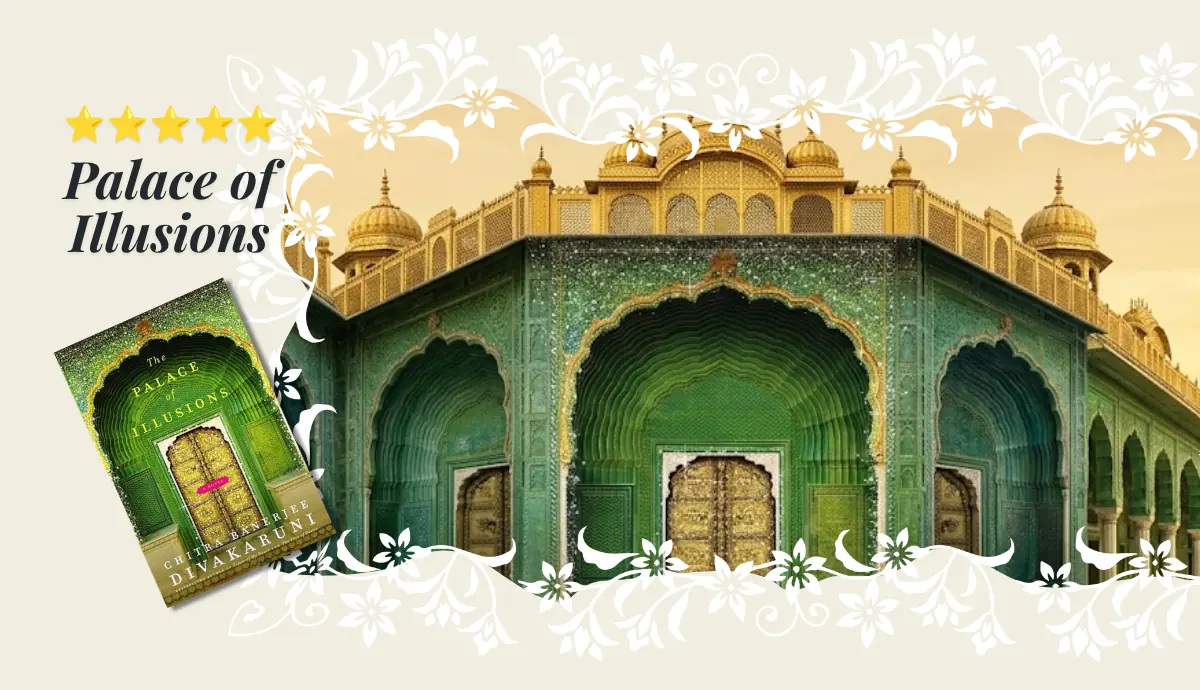
Rating: ⭐⭐⭐⭐
"She is a woman trying to forge a destiny in a man's world. And so am I."
- from A Palace of Illusions by Chitra Banerjee Divakaruni
It is a daring endeavour to attempt to rewrite one of the world's most enduring stories and Chitra Banerjee Divakaruni does this beautifully. She gives Draupadi, also known as Panchaali, a voice that shouts the struggles of contemporary women, experiences gut-wrenching situations while trying to cement her identity in a male-dominated world.
While there are some creative liberties that changed the content of the original Mahabharata (like Panchaali being cherished by King Drupad in the original Mahabharata while in Palace of Illusions, she's seen as a burden), the book covers most of the events in the Mahabharata, but keeps Draupadi's perspective as a focal point.
Somehow, as a reader, I knew what to expect and was still left struck by eye-opening revelations. Having grown up with a singular version of the Mahabharata, it was like getting my hands on precious behind-the-scenes footage of a revered TV character. I had added this remarkable book to my TBR list in 2022 and I am grateful that I finally got around to reading it.
Impressions
Conflicting Eras
Initially, I had conflicting feelings about the overt portrayal of Draupadi as having anthropogenic emotions such as crude jealousy, superficial romanticisation and blinding anger. It seemed to go against my intrinsic belief in viewing her and other mythical figures as transcendent beings, believing them to be larger than life itself. At times, the dialogues felt as if the author exercised too much of artistic license in infusing these contemporary feelings into a narrative that was fundamentally rooted in antiquity. Having said that, the fact that Draupadi was portrayed to be so flawed added depth to her character, which was perhaps the intention of the author. Plus can I really blame her for seething with anger for the majority of her life?
Refreshing Perspectives
I found myself comparing what I knew from the original telling of Mahabharata, going into personal tides of side-lined research and marvelling at how one can simply disregard a perspective by not questioning it. For instance, Draupadi's resistance to polyandry, a seemingly traditionally accepted norm, consisted of going to extreme lengths like starving herself and breaking expensive items. The way the original Mahabharata has been told, or at least, the way I've remembered it, was more of an objective recounting of events of Draupadi marrying the 5 Pandavas, rather than a genuine portrayal of fully-realised beings with opinions and feelings. This exposure to the breadth of perspectives allowed me to understand the justifications of their actions better, while realising that sometimes the clarity only comes with hindsight.
Writing Style
I was skeptical that the writing style would be overly complex but it turned out to be extremely accessible and pleasing. I especially liked the easter eggs (for the lack of a better term) of Vyasa, the all-knowing sage. While his portrayal was still full of gravitas and mystical foreboding, there was a playfulness with which his banter with Draupadi is explored. As I mentioned before, given that the readers are already familiar with the epic's events, the dramatic irony was enough to heighten the tension and anticipation throughout the narrative.
Overall, I couldn't stop reading the book and really enjoyed it. At the risk of sounding like a broken record, I definitely recommend it. It's a relatively light read of 384 pages and amazing writing.
Who Should Read It?
Anyone who has an interest in Hindu mythology or would just like to brush up on the Mahabharata from a different perspective. It is also a must-read for those who appreciate strong female protagonists and seek a deeper understanding of the complexities of gender and power within narratives.
My Top Quotes
"Can't you ever be serious?" I said, mortified. "It's difficult," he said. "There's so little in life that's worth it."
"Wait for a man to avenge your honor, and you'll wait forever."
"All this time I'd believed in my power over my husbands. I'd believed that because they loved me they would do anything for me. But now I saw that though they did love me – as much perhaps as any man can love – there were other things they loved more. Their notions of honour, of loyalty toward each other, of reputation were more important to them than my suffering. They would avenge me later, yes, but only when they felt the circumstances would bring them heroic fame… The choice they made in the moment of my need changed something in our relationship. I no longer depended on them so completely in the future. And when I took care to guard myself from hurt, it was as much from them as from our enemies."