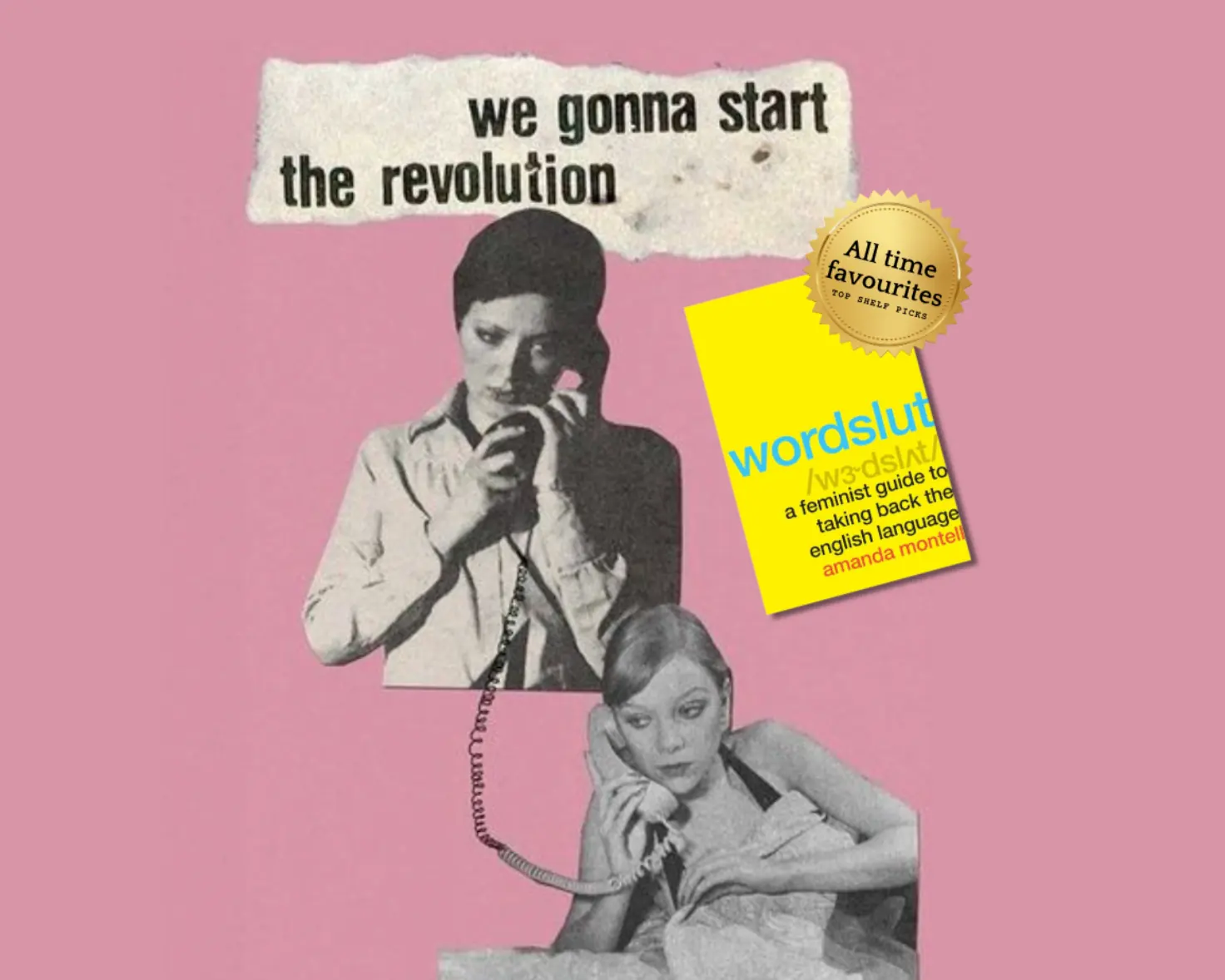
Rating: ⭐⭐⭐⭐⭐
"I think the golden rule for men should be: If you're a man, don't say anything to a woman on the street that you wouldn't want a man saying to you in prison."
- from Wordslut by Amanda Montell
As a sincere fan and regular user of the English language, learning about the etymologies of certain words/phrases never gets old. The only way it gets better is through a lens of sociolinguistics to learn the way language and gender intersect. The author, Amanda Montell, describes this book as "the psychedelic universe that exists behind the English language" as it takes us through the impact of speech styles in our daily interactions, the semantical disparity between the insults used for males and females and historically skewed evolutions of some of our favourite phrases.
It's a humbling yet conflicting experience to disagree with parts of a book and still emerge from its pages with newfound, eye-opening perspectives. Montell's hilarious writing style had me laughing out loud multiple times, while the questions she put forth made me review the inadvertent use of language biases.
Male until otherwise-indicated
We know that man and person are oftentimes synonymous in English. We see it in phrases like "no man is an island" or "a dog is a man's best friend" or "need every man on deck". While it is commonplace to use in idioms and historic literature, this pervasive assumption becomes harmful when it is extrapolated to professions like actors, scientists, lawyers, and doctors. Such a disparity is further reflected when we use terms like "female doctor" or "woman scientist."
You know the scene in Modern Family when Alex attends a seminar for "being your own SHE-EO"? Montell reminds us that terms like SHE-EO and girlboss just illuminate that words like entrepreneur and CEO are not inherently gender-neutral terms but are tacitly coded as male. Similarly, for words like 'Mompreneur' or 'Fempreneur', she argues that while they make for trendy hashtags, they don't work towards undoing implicit sexism in language, they reinforce them instead.
While I do agree that such diminutive language can be counter-productive (and infantilise women's leadership positions), I wonder if it's actually doing more harm than good. In male-dominated industries, terms like SHE-EO and Mompreneur are often used for empowerment and community building in a landscape where woman representation is lacking, celebrating the unique experiences of being a woman in business. Perhaps there is a balance where the fight to reclaim the gender-neutral lexicon persists while differentiating the branding of SHE-EOs and Mompreneurs.
Bitch, Please!
"If you want to insult a woman, call her a prostitute. If you want to insult a man, call him a woman."
- from Wordslut by Amanda Montell
A survey of gendered insults at UCLA revealed that almost 90% of all recorded slangs for women were negative, compared to only 46% for men. In fact, even the "positive" terms compared women to food: peach, treat, cupcake. Some of my favourite fill-me-with-rage evolutions were:
- The evolution of master and mistress: formerly indicated people of authority in the old French. Over time, only the feminine term got contaminated to mean a sexually promiscuous woman with a married man. Meanwhile, master continues to mean 'in charge' or even 'conquer a difficult skill'.
- Similarly, buddy and sissy, which were originally abbreviations of brother and sister, evolved unevenly. Buddy came to mean a close pal, whereas sissy refers to a weak or an overly effeminate man.
- Hussy, originally a shorter version of Old English husewif (female head of household), is now used to describe a lewd woman or prostitute.
- The word Slut: the Middle English term used to be slutte, which merely meant 'untidy' woman, which soon enough extended to mean a sexually loose woman and got fortified in pornography by the late 1990s. Interestingly, there is a male equivalent - manslut - which not only has a lighter connotation but also reinforces that slut with no modifier is inherently female and implies, as Montell puts it, "promiscuity is only contemptible when women do it."
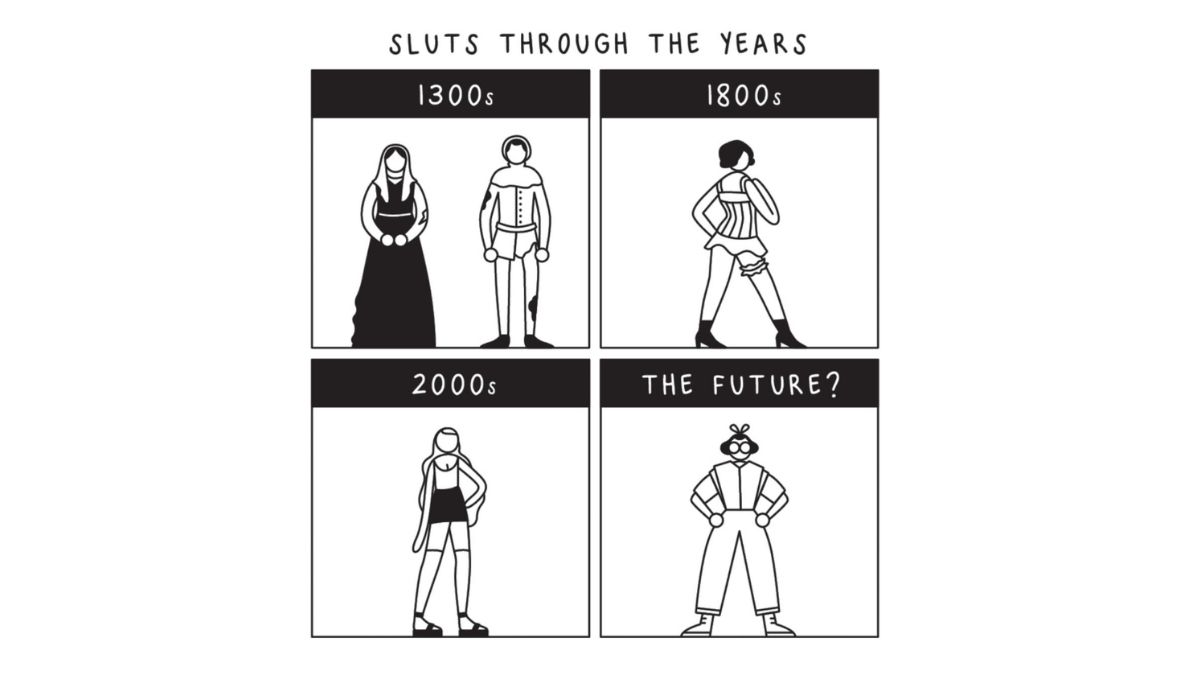
Montell links this sexually-centred semantic evolution to human history. When homo sapiens lived free, nomadic lifestyles wandering from place to place, men and women had multiple sexual partners and female sexuality was normal and encouraged. Then humans stopped moving, owning land became desirable, the idea of passing it down to children arose, and in order for men to know their children, female monogamy became a must. Goddess-like female sexual liberation went kaput.
Do such terms ever ameliorate? Why, yes they do! For men, mostly.
- The word stud, originally a male breeding animal, turned into a slang for a hot, manly dude.
- Knight, originally meant as a young boy or servant, now is a gallant gentleman.
- Interestingly, the word queer used to be exclusively a homophobic insult, but it has gone through an impressive self-affirming turnabout by academics and the LGBTQ+ community.
Montell outlines the ways females have been reclaiming some of these insults. For instance, Black female recording artists pioneered bad bitch to mean a confident, sassy woman. Feminist mogul Andi Zeisler mentions that the way to reduce harm of gendered insults is to avoid using them abusively ("Wow, impressive, she's a bad bitch!"). Another way is to take the so-called "contemptible promiscuity" out of words like slut or whore ("Zack is such a slut for McDonald's fries").
Can you, like, not?
When I think 'girl talk' I think the banal assumption of superficial gossip and intimate conversation. When linguists think 'girl talk' they think genderlects: speech styles evolving differently between men and women.
UC Berkeley's Robin Lakoff observed some characteristics of women's speech: vocal fry, valley girl talk (think Kim Kardashian), saying like after every other word, apologising too much, using hyperbolic internet slang (OMG I AM LITERALLY DYING), speaking with uptalk (ending a declarative sentence with the upward intonation of a question), ultra-polite language (would you mind if I…), tag questions (this movie was good, wasn't it?). He claimed that this happens because women are socialised to be deferential and unassertive. Contrastingly, Montell claims that people see aspects like softening hedges as signs of uncertainty and hesitancy but they're actually used to help create trust and empathy. They've been used to save face of all participants, negotiate sensitive topics and encourage participation of others. For instance, females use minimal responses like yeah, right, mh-hmm to demonstrate active listening and consensus.
Having been trained in public speaking, and grown up hearing Indian English, hedging or any form of 'uncertainty' in language was shamed out of me pretty early on. So it was interesting to see Montell's reasoning for why these are good: Vocal fry is low in pitch so it turns out to be a way for women to compete with men's voices. Using 'like' can be used as a discourse marker to help a person connect, organise or express a certain attitude with their speech ("Like, this suit isn't even new"). Uptalk can be a way to state an opinion confidently while opening for others' responses.
So whether you like it or not, the idea is that instead of deploring the way women speak, focus on the context behind their proclivities, or better yet, their content.
"One of our culture's least helpful pieces of advice is that women need to change the way they speak to sound less 'like women' (or that queer people need to sound straighter, or that people of colour need to sound whiter)."
- Amanda Montell
"I've heard the satirical argument that women were given purses to hold and high heels to wear to physically slow them down. While I don't take this sentiment literally, I think you can compare it to the critique of women's voices, which are there to steal the focus away from the content of their statements, while distracting women with the anxiety of how their speech sounds to other people."
- Amanda Montell
Montell covers much more in her book, including the gender changes in different languages and what they reveal about culture, the history of the English lexicon, and how various social communities interact with language. It may seem like I've spoiled the book, but truly, reading it is an experience in itself.
What I took away from this is that small changes matter. Simple, mindful corrections can lead to shifts in society's social fabric. However, social media can be tricky to navigate. For instance, reels of "#womeninmalefields" show satirizing behaviors usually associated with men; it's light-hearted and fun, but at some point, we have to ask if it unintentionally risks deepening the chasm between genders on a macro scale or reinforcing those behaviors. Are other hashtags like "girlmath" or "Imjustagirl" implicitly denigrating the experience of being a woman? The good thing is that we have the opportunity to engage in digital consciousness-raising by resharing humorous content while also fostering inclusive dialogue and being mindful of our impact.
Let's create change, one word at a time. Because, like, it's important?